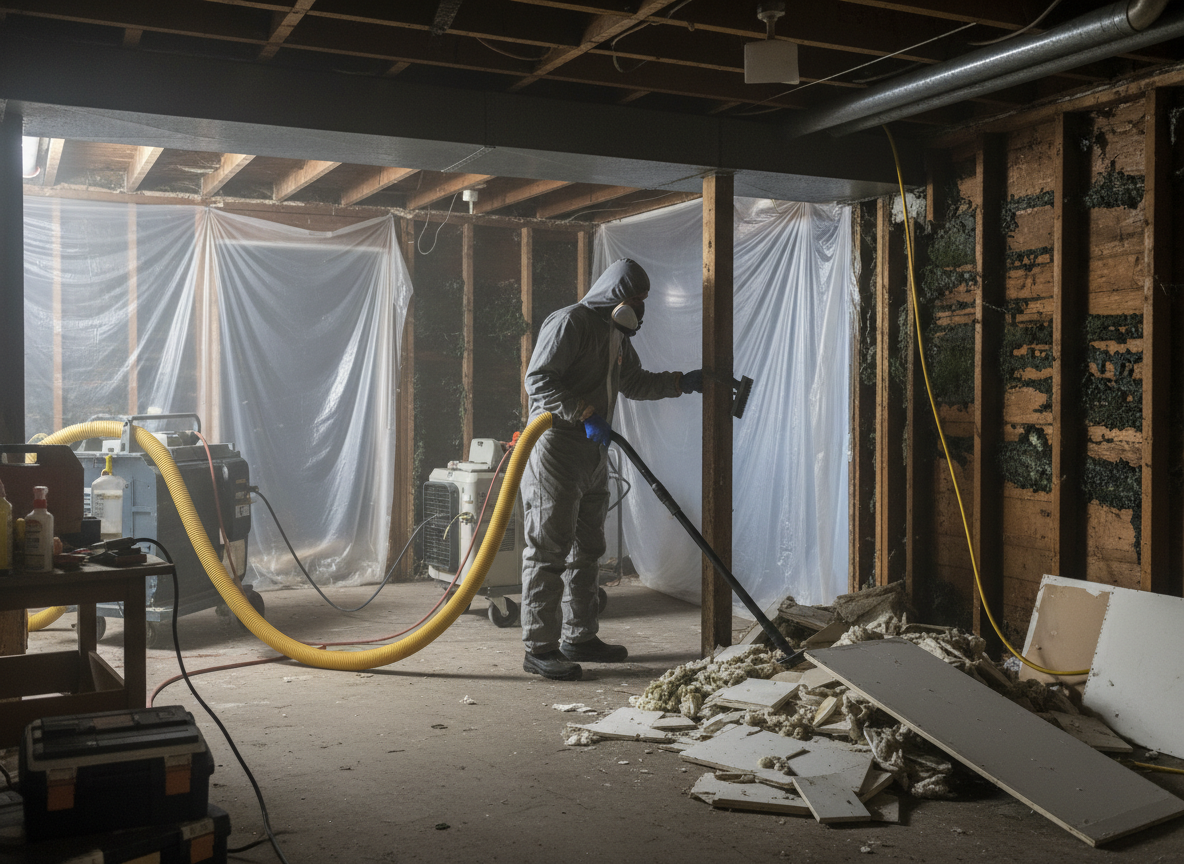
In Salt Lake County homes built before the 1990s, especially those in Harvest Park and along the western edges of Riverton, water from winter pipe bursts often travels behind plaster or into crawl spaces before homeowners notice. Once temperatures swing from cold nights to daytime warming, residual moisture feeds mold colonies on framing and insulation that standard drying fans miss. Remediation here requires cutting back affected drywall at least 18 inches past visible growth, HEPA vacuuming settled spores, and applying antimicrobial agents rated for porous surfaces common in these older builds.
Hot semi-arid summers in Riverton dry surfaces fast on the outside while trapping humidity inside walls after summer storms or irrigation leaks from nearby fields. This creates edge cases where mold appears only on the back side of cabinets or under flooring in Western Springs properties. Technicians must use moisture meters on multiple layers and sometimes pull baseboards to check subfloors, because skipping these steps lets colonies return within weeks once the next cold front arrives.
Local building practices around Riverton City Park often include finished basements without proper vapor barriers, so water from above-grade leaks pools against concrete and wicks into wood sill plates. Remediation protocols therefore include negative air machines exhausting through windows facing Old Dome Meeting Hall to avoid spreading spores into living areas. Every job ends with post-remediation verification sampling to confirm spore counts match outdoor baselines before any reconstruction begins.
Technician insight
In Riverton, the thing that catches most people out with Mold remediation after water damage is how quickly cold winter air hides moisture inside uninsulated walls of homes built in the 1980s around Western Springs. Homeowners run box fans after a leak and think it is dry, but the temperature drop at night pushes condensation back into the cavities where we later find colonies along the sill plates.
Hidden Growth After Irrigation Line Leak
A homeowner in Riverton Meadows noticed a musty smell weeks after an irrigation line leak near the foundation. We found mold on the back of drywall and subfloor joists that standard drying had missed. Removal extended two feet past visible growth, followed by targeted drying and verification sampling before the space was cleared for repairs.
How it works
- 1
Initial Assessment
Technicians arrive from the 1926 W 12600 S location and map moisture with meters across affected zones in Riverton Meadows or adjacent neighborhoods.
- 2
Containment Setup
Plastic barriers and negative air pressure isolate the work area to prevent spore migration into unaffected rooms.
- 3
Removal and Cleaning
Damaged materials are removed, surfaces are HEPA cleaned, and antimicrobial treatments are applied to remaining structure.
- 4
Drying Verification
Dehumidifiers and air movers run until moisture readings reach safe levels, followed by clearance testing.
- 5
Documentation Handover
Homeowners receive a written scope of work and photos showing conditions before and after remediation.
Pricing
Cost depends on square footage affected, depth of hidden growth, and whether structural materials must be removed.