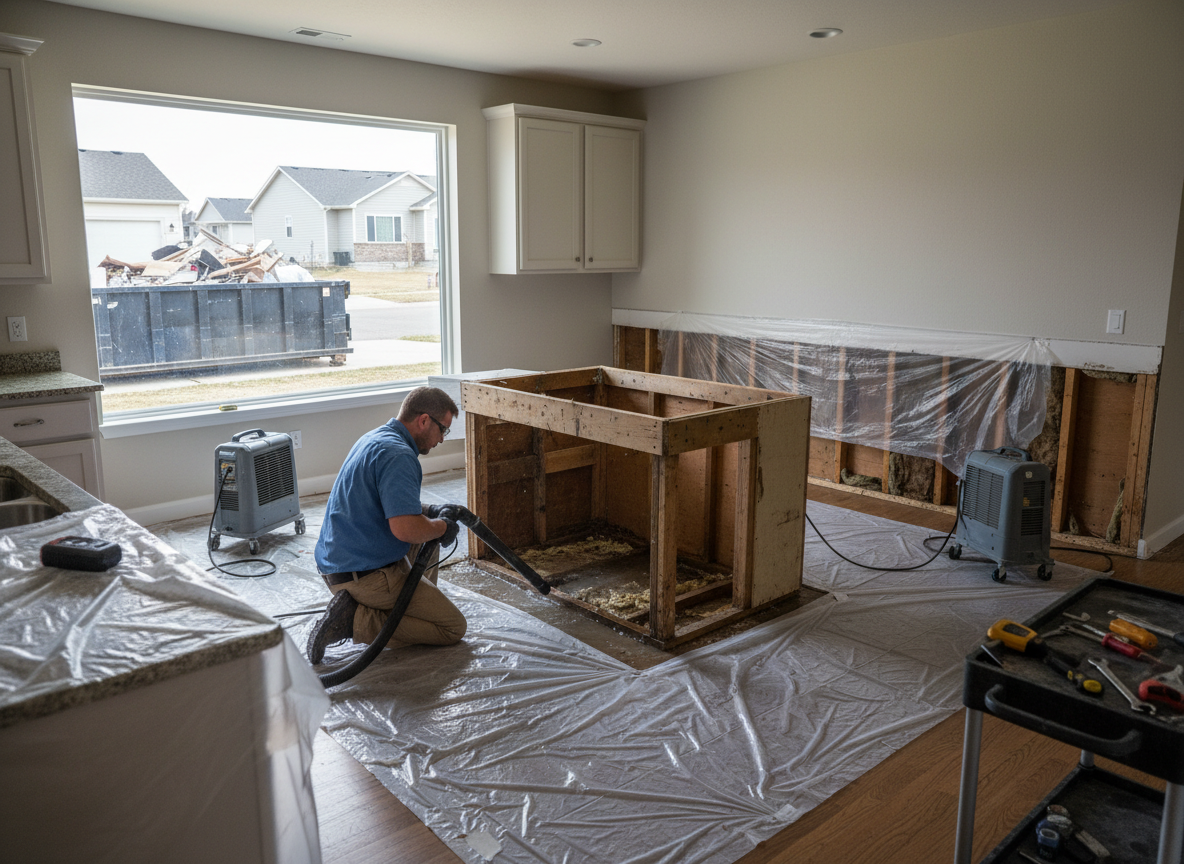
Kitchen water damage in Riverton often starts from dishwasher or sink supply lines that leak under cabinets, soaking particleboard bases and laminate flooring common in homes built through the 1990s in Harvest Park and Western Springs. Once moisture reaches the subfloor, it can wick into adjacent drywall before homeowners notice musty odors. Cold winter nights in Salt Lake County drop temperatures enough to stress older copper or PEX joints, turning a small drip into widespread saturation that requires full cabinet removal rather than simple drying.
Restoration crews address these jobs by first isolating the water source, then using moisture meters to map hidden saturation behind toe kicks and under vinyl or tile. In semi-arid conditions with low humidity, rapid drying prevents secondary mold, but crews still pull baseboards and sometimes sections of flooring to reach trapped moisture near the foundation. South Jordan and Herriman homes share similar tract construction, so the same cabinet and underlayment replacement patterns appear across the region.
Homeowners in Riverton Meadows frequently discover damage only after a refrigerator ice-maker line bursts during a freeze, sending water across the kitchen and into the family room. Technicians cut away saturated drywall up to the flood line, treat affected framing with antimicrobial, and reinstall with moisture-resistant materials to meet current Salt Lake County building practices. Full drying with air movers and dehumidifiers typically takes three to five days before new cabinetry or flooring can be installed.
Technician insight
In Riverton, the thing that catches most people out with Kitchen water damage repair is how quickly leaks travel under the toe-kick into the particleboard base of 1980s and 1990s cabinets in Harvest Park homes. Cold winter nights expand small joint leaks that then saturate the subfloor before anyone smells it. We always pull the toe-kick first instead of just drying from above.
Ice-Maker Line Failure in Western Springs
A slow leak from a refrigerator line in a Harvest Park kitchen went unnoticed until water reached the family room carpet. We isolated the line, mapped moisture through the subfloor, removed the saturated cabinet base and underlayment, then ran drying equipment for four days. The kitchen was ready for new flooring and cabinet repair without mold growth.
How it works
- 1
Source Isolation and Safety Shutoff
Locate and stop the leak from the sink, dishwasher or ice-maker line, then verify no active water flow remains in the kitchen.
- 2
Moisture Mapping and Containment
Use meters to trace water migration into cabinets, flooring and walls, then set up containment to protect unaffected rooms.
- 3
Water Extraction and Initial Drying
Remove standing water, pull wet cabinet bases if needed, and place air movers plus dehumidifiers to begin drying the structure.
- 4
Material Removal and Antimicrobial Treatment
Cut away saturated drywall, underlayment or cabinetry, treat exposed framing, and document all removed materials for insurance.
- 5
Final Drying Verification and Handover
Confirm moisture levels meet industry standards, reinstall or coordinate replacement finishes, and provide the homeowner with a drying log.
Pricing
Upfront quotes after inspection; final cost depends on square footage affected, cabinet material, and whether subfloor replacement is required.