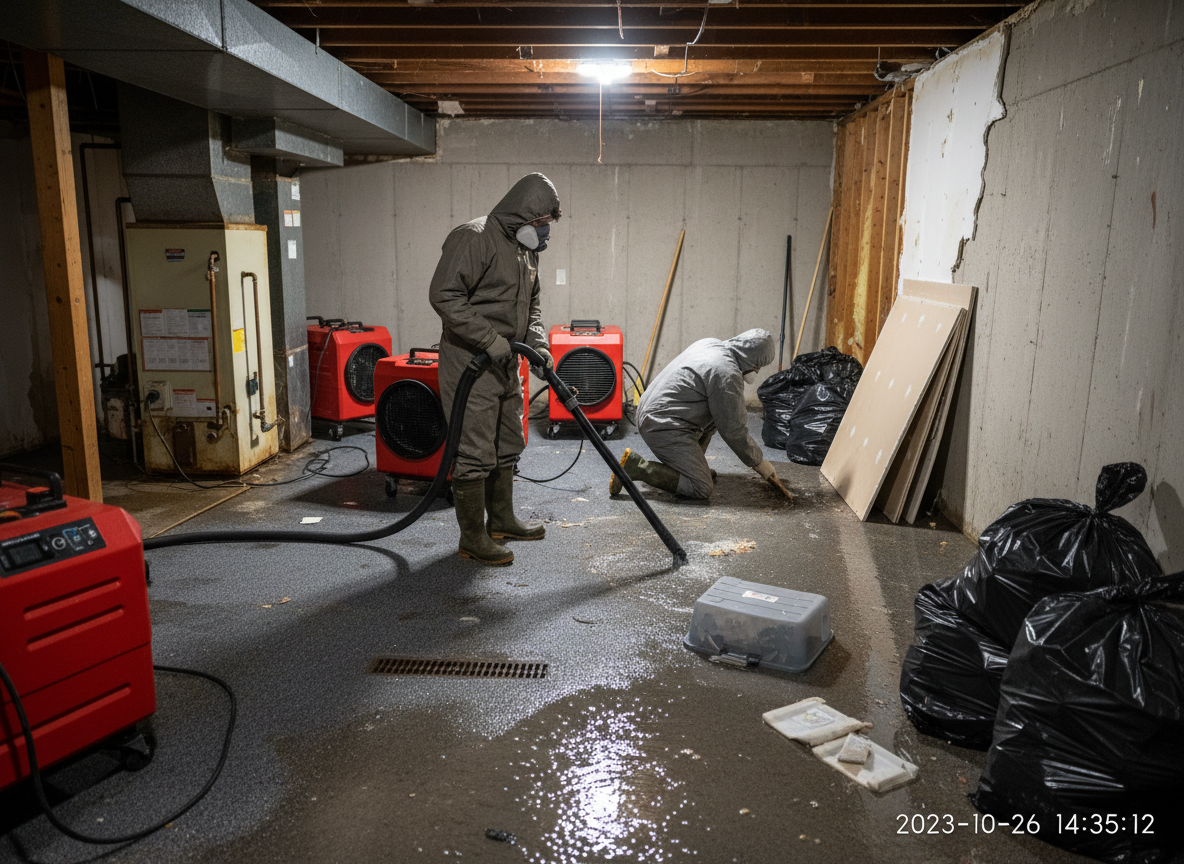
Riverton sits in semi-arid Salt Lake County where cold winters bring heavy snow that melts fast in spring and sends water toward older basements in Riverton Meadows and Western Springs. Many homes there have concrete foundations poured before modern drainage standards, so water finds hairline cracks and saturates the slab. Crews see the same pattern after summer thunderstorms when runoff from nearby Herriman hills overwhelms French drains that were never sized for the clay soil common in Harvest Park.
Extraction starts with submersible pumps to drop standing water below the slab, followed by air movers and dehumidifiers that must run longer here because low humidity outside actually pulls moisture back out of porous block walls. Technicians check for hidden saturation behind finished walls near the Old Dome Meeting Hall area, where many basements were finished without vapor barriers. Skipping that step lets mold take hold within days once temperatures climb again.
After drying, the focus shifts to preventing recurrence. That often means adding interior perimeter drains tied to a sump pump with battery backup, especially in homes close to Riverton City Park where the water table sits higher. Every job ends with a moisture map so homeowners know exactly which areas were treated and which remain at risk during the next cold snap.
Technician insight
In Riverton, the thing that catches most people out with Basement flood cleanup is how the heavy clay soil around Harvest Park and Western Springs holds meltwater against foundations long after the snow is gone, so a single extraction job often turns into repeated seepage if the homeowner skips the perimeter drain upgrade.
Spring Melt Flood in Riverton Meadows
A homeowner in Riverton Meadows called after snowmelt pushed water through a foundation crack into the finished basement. Extraction removed several inches of water, but hidden saturation remained behind drywall near the utility room. Equipment ran for five days until readings stabilized, then new base trim and a small interior drain line were installed to handle future melt events.
How it works
- 1
Initial Assessment
Technicians arrive from the Riverton address, locate the water source, and map affected zones in the basement while noting construction type and any prior repairs.
- 2
Water Extraction
Standing water is removed with pumps rated for the volume typical in local basements, then remaining moisture is pulled from carpet pads, flooring, and wall cavities.
- 3
Drying and Monitoring
Industrial drying equipment runs until readings match dry standards for Salt Lake County homes, with daily checks to adjust placement as conditions change.
- 4
Final Restoration
Damaged materials are replaced or repaired, drainage improvements are discussed, and the space is returned to pre-loss condition.
Pricing
Upfront quotes based on water volume, affected square footage, and drying time required; no hidden fees after the initial assessment.