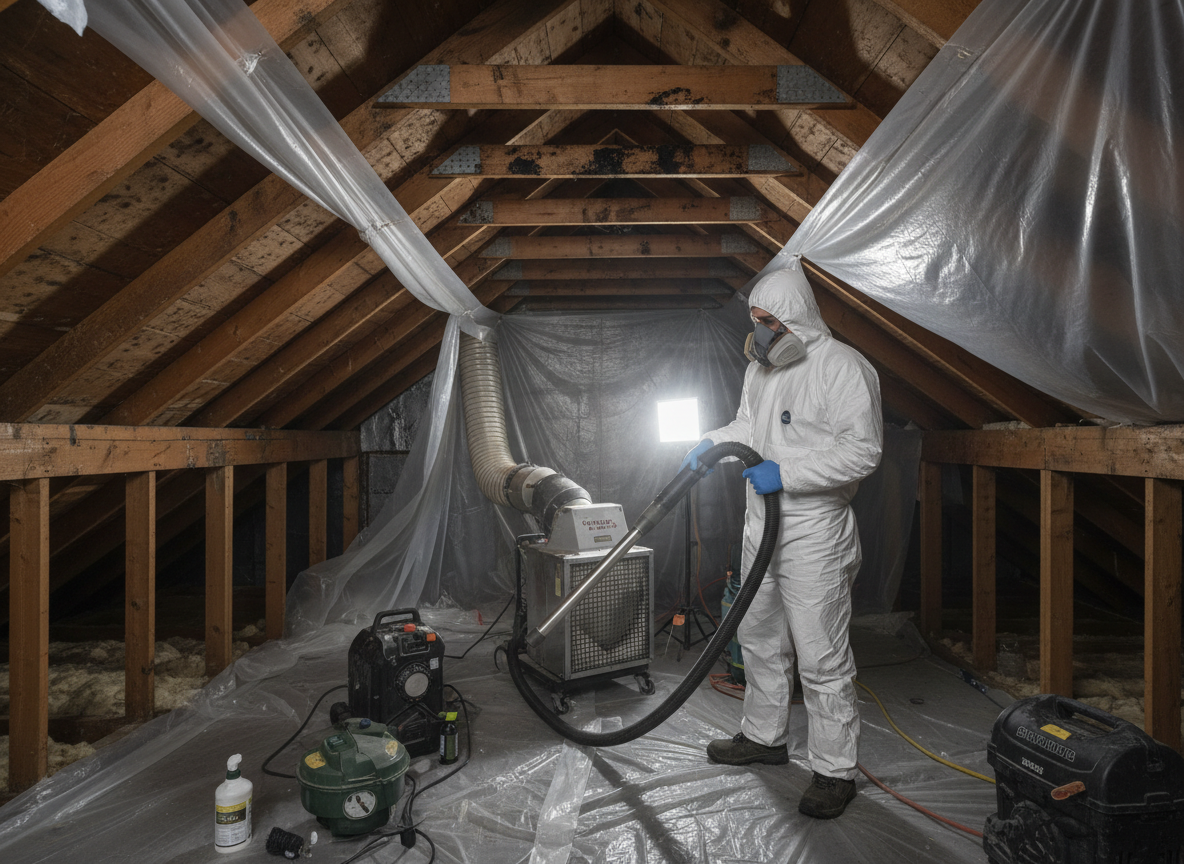
Attic mold in Riverton often starts from roof leaks or poor ventilation that lets warm, moist air meet cold sheathing during winter. Single-family homes in neighborhoods like Western Springs and Harvest Park frequently have older fiberglass batt insulation and limited ridge vents, so condensation pools along the north-facing slopes. We begin with moisture mapping and air sampling to locate hidden growth behind rafters before any removal starts. Containment barriers and negative air machines keep spores from drifting into living spaces below, especially important in two-story homes near Riverton City Park where open stairwells can spread particles quickly.
Removal follows IICRC S520 guidelines using HEPA vacuums and antimicrobial treatments on wood surfaces. In semi-arid Salt Lake County, summer heat can bake mold into drywall paper, while winter freezes push ice into small roof gaps around chimneys and vents. We replace saturated insulation, improve soffit airflow, and add vapor barriers where needed. Homeowners in nearby Draper and South Jordan often discover mold only after noticing ceiling stains, so we always check the entire attic plane rather than spot-treating visible patches.
Access challenges arise in homes built on the slight slopes common in Harvest Park, where low-pitch roofs limit crawl space. We document every step with photos and moisture logs so insurance adjusters see the full scope. Post-remediation clearance testing confirms spore counts return to outdoor baselines before we restore insulation and seal penetrations.
Technician insight
In Riverton the thing that catches most people out with attic mold remediation is winter condensation on the north roof deck in older Harvest Park homes. Those single-story ranches from the seventies often have only gable vents and no ridge vent, so even a small ice dam leak turns into widespread mold once temperatures drop below freezing.
Western Springs Attic Discovery
A homeowner in Western Springs noticed ceiling spots after a heavy January snow. We found widespread mold along the north rafters caused by blocked soffit vents and poor insulation. Containment, removal of saturated batts, and added ridge venting restored safe conditions without affecting the main living areas.
How it works
- 1
Initial Inspection
Moisture meters and thermal imaging locate active leaks and hidden mold colonies throughout the attic.
- 2
Containment Setup
Plastic barriers and negative air establish a sealed work zone to protect the rest of the home.
- 3
Mold Removal
HEPA vacuuming, surface cleaning, and removal of affected insulation and drywall paper.
- 4
Drying and Prevention
Dehumidification, ventilation upgrades, and new insulation to stop future condensation.
- 5
Clearance Testing
Air sampling confirms mold levels match outdoor baselines before final cleanup.
Pricing
Pricing depends on attic size, mold extent, and access; we provide upfront written quotes after inspection.