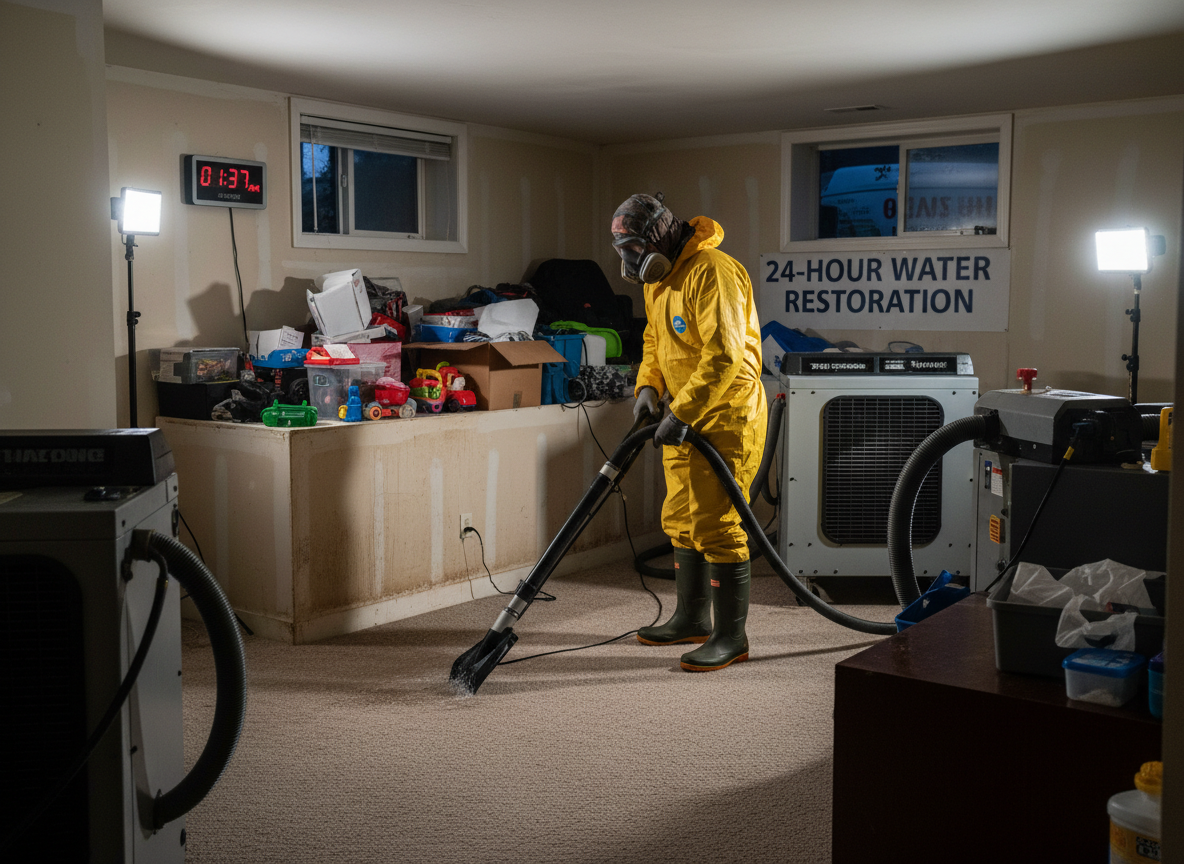
In Riverton’s semi-arid climate, cold winter nights regularly drop below freezing and expand water in supply lines inside homes built from the 1980s onward in Western Springs and Harvest Park. When those lines fail, water travels quickly through slab-on-grade foundations and into the sandy subsoil typical of Salt Lake County, creating hidden saturation that standard fans miss. A 24-hour water restoration near me call often begins with infrared mapping to locate moisture behind drywall and under vinyl plank before mold sets in during the short spring thaw window.
Summer monsoon cells can dump an inch of rain in thirty minutes on the flat terrain around Riverton City Park and the Old Dome Meeting Hall. Runoff pools against south-facing walls in Riverton Meadows because the native clay-loam soil drains slowly once the water table rises. Technicians responding at 2 a.m. from 1926 W 12600 S carry submersible pumps sized for these sudden loads and know to check the low spots along 12600 South first, where water backs up from the Jordan River corridor.
Older ranch homes in the area frequently have cast-iron waste lines that crack at the joints when soil shifts after irrigation season. A 24-hour water restoration near me visit must include camera scoping of the line before any drying equipment is placed, because negative pressure from air movers can pull contaminated water into living spaces. Crews also note that many Harvest Park basements were finished without proper vapor barriers, so moisture readings are taken at multiple depths in the concrete to prevent recurring odor after the job is closed.
Technician insight
In Riverton, the thing that catches most people out with 24-hour water restoration near me is how quickly water migrates under the sandy fill beneath 1980s slabs in Western Springs once a supply line freezes and bursts; homeowners often stop at surface drying and miss the moisture that later wicks back up through baseboards during the first warm spell.
Frozen Line in Riverton Meadows
A homeowner in Riverton Meadows discovered standing water in the laundry room after a January freeze. Inspection found a split copper line under the slab that had sent water into the sandy subgrade and up into the adjacent wall cavity. Extraction and targeted drying prevented mold growth; the home was returned to normal moisture levels within four days.
How it works
- 1
Immediate Response and Containment
Technician arrives within the hour, shuts off water if still flowing, and sets up containment to protect unaffected rooms in the Riverton home.
- 2
Moisture Mapping and Extraction
Infrared cameras and moisture meters locate water in walls, floors and soil; water is removed with truck-mounted and portable extractors suited to local slab construction.
- 3
Drying and Monitoring
Air movers and dehumidifiers are positioned based on Salt Lake County humidity swings; daily readings continue until all materials return to normal moisture content.
- 4
Final Verification and Handover
Post-drying inspection confirms no residual moisture remains behind finishes; homeowner receives written report and guidance on preventing winter pipe issues.
Pricing
Upfront quotes after on-site inspection; final cost depends on water volume, affected square footage and drying duration.